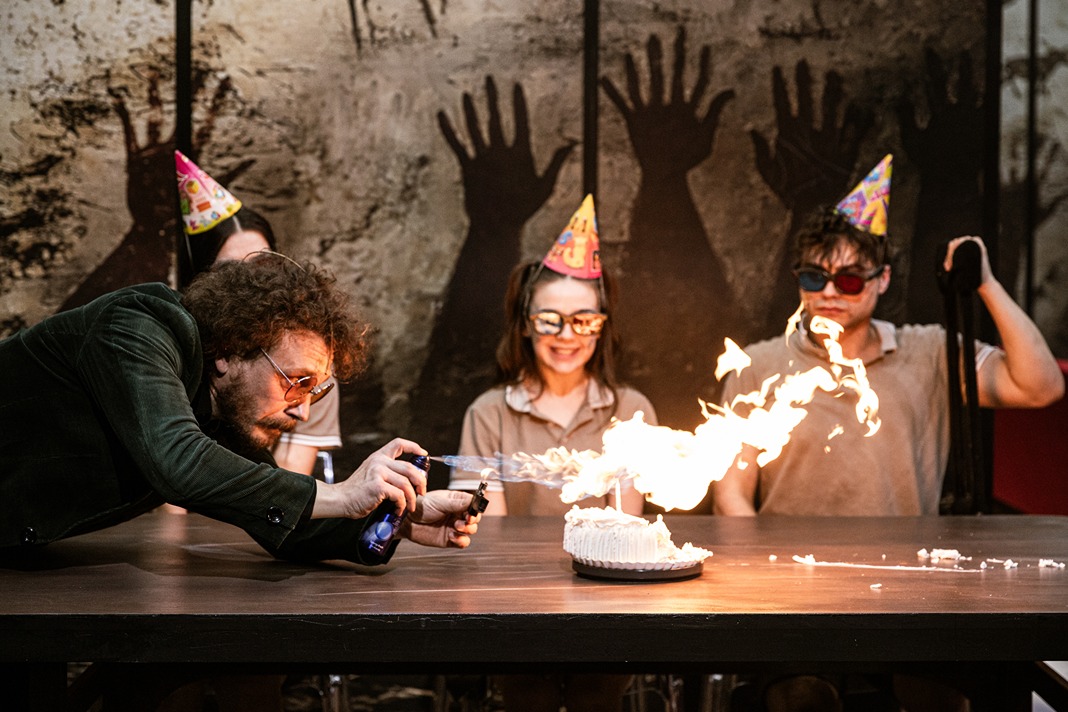
19 October | 21:00 – „I.L. Caragiale” National Theatre, Pictură Hall
20 October | 18:00 – „I.L. Caragiale” National Theatre, Pictură Hall

A possessive father, with a dictatorial temperament, keeps his wife and children captive at home, in a carceral universe that is meant to protect them from the dangers outside, when in fact their greatest enemy is within those four walls.
[same_day_events_link]
Adapted freely after the movie Kynodontas by Yorgos Lanthimos and Efthimis Filippou
Dramatised by: Diana Nechit and Andrei C. Șerban
Cast:
Father: Barna Bokor
Mother: Elena Purea
Older sister: Loredana Dascălu
Younger sister: Larisa Dobrin
Son: Daniel Suciu
Cristina: Ale Țifrea
Director/Dog trainer: Luchian Pantea
Directed by: Botond Nagy
Set design: Raul Cioabă
Costume design: Ioana Ungureanu
Original music and sound design: Claudiu Urse
Light-design: Cristian Niculescu
Produced by: Târgu-Mureș National Theatre – „Liviu Rebreanu” Company
Recommended age: 16+
WARNING! The performance contains explicit language and emotionally intense scenes of physical, verbal, and psychological violence. Strobe lighting and odorless stage smoke are used during the show. Not recommended for people with epilepsy, pacemakers, pregnant women, or individuals with respiratory difficulties.
Duration: 1h 50min (no interval)
In Romanian with English surtitles
Father, mother, and their three children live at the outskirts of a city. Their house is surrounded by tall fences that were never crossed by the children, who believe that planes are toys and that zombies are tiny yellow flowers. There is a single person who can enter this prison-type universe: Cristina. A radical fable about totalitarianism, patriarchy, and education. With a splash of unfiltered, grotesque humor. A septic violence in unexpected doses connects us to realities that we sometimes reject, but which are all flooding the mass media.
A free adaptation after the feature film Kynodontas (2009) by filmmaker Yorgos Lanthimos, dating from the period wisely named „Greek-weird“, the spectacular premises propose the recreation of an „aseptic“ space, of a dystopia in which a father subjects his family to perpetual isolation; a distortion of reality to the point where it becomes an artificial construct where language is devoid of its relation with the referent, with the linguistic sign. Fear is the engine of this forced homebound reeducation: fear of freedom, fear of knowledge, fear of the influences from books and culture, fear of love, and of all the „vices“ that the exterior can employ to „contaminate“ the good education and the morality of this family.
Photos: Cristina Gânj (Bristena