22 October | 20:00 – „I.L. Caragiale” National Theatre Bucharest, Studio Hall
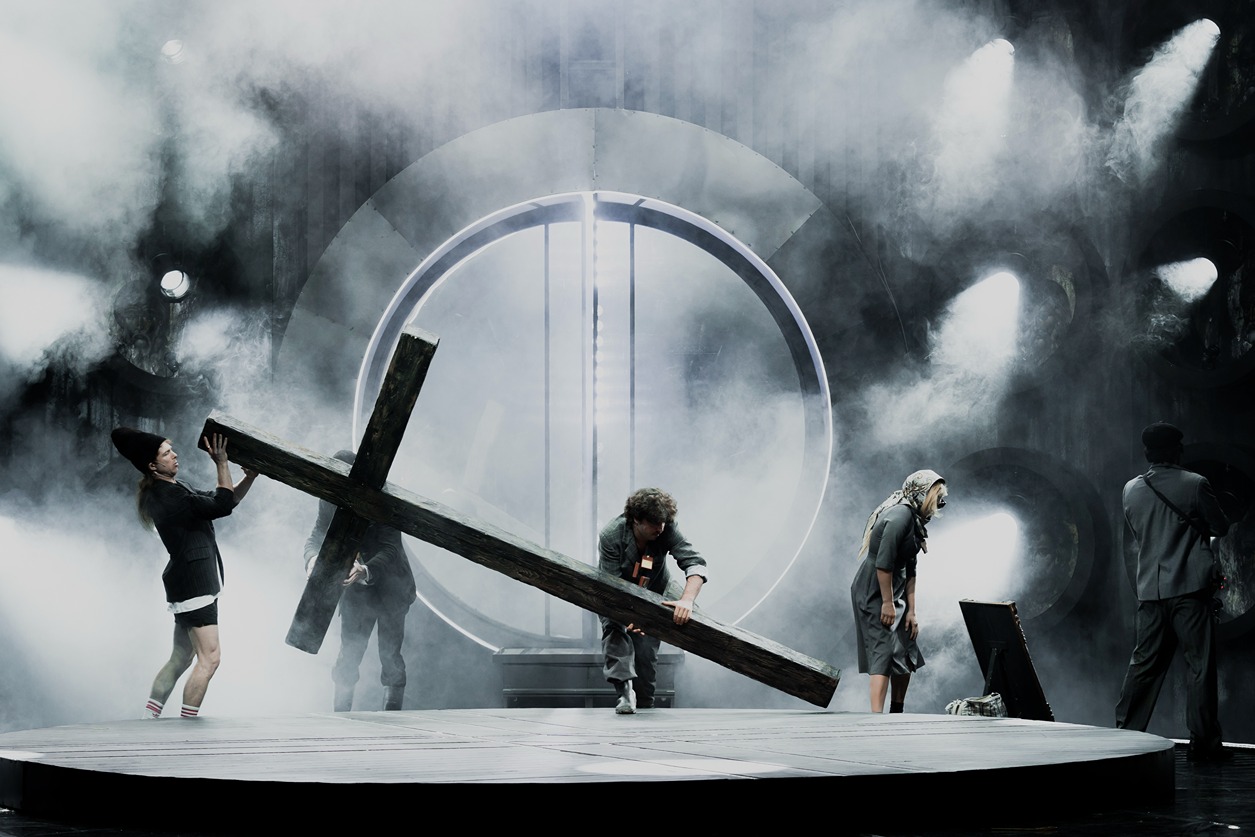
In Prophet Ilya, the Polish playwright Tadeusz Słobodzianek recreates the apocalypse of humanity, inspired by the true story from the 1930s and 1940, the story of the preacher Eliasz Klimowicz, a story that “mirrors like a crystal ball all the utopias of the 20th century: Christianity, nationalism, socialism…”.
[same_day_events_link]
By: Tadeusz Słobodzianek
Translated by: Luiza Săvescu and Passionaria Stoicescu
Cast:
Ilie, countryside prophet: Richard Bovnoczki
Olga, sinner, later saint: Aylin Cadîr
Wiera, saint, later sinner: Florentina Ţilea
The Drunkman: Silviu Mircescu
Rotschild, merchant from Bialystok: Emilian Mârnea
Bumblebee, later Scarecrow: Răzvan Oprea
Pałaszka, later Pilate’s Wife: Ofelia Popii
Marczuk, later Roman soldier: Florin Călbăjos
Hariton, later Judas: Lari Giorgescu
Aćko, later Pilate: Leonard Chionac
Young Women, later Saint Veronika: Laura Gabriela Oana, Teo Dincă
The blind man, father of the young women: Vitalie Bichir
The Catholic Man, later Herod: Mihai Calotă
Dramaturgy by: Diana Nechit
Directed by: Botond Nagy
Set design by: Irina Moscu
Lighting and video design: Cristian Niculescu
Original music and sound design: Claudiu Urse
Produced by: „I.L. Caragiale” National Theatre Bucharest
Recommended age: 18+
Emotionally disturbing scenes, licentious language, and scenes with sexual connotations.
Due to stroboscopic and light effects of short duration and intensity, the show is not recommended for people with photosensitivity and those who suffer from epilepsy! The performance uses odorless stage smoke!
Duration: 2h5min (no interval)
In Romanian with English surtitles
Inspired by the true story of the preacher Eliasz Klimowicz in the 1930s and 1940s, because it “mirrors like a crystal ball all the utopias of the 20th century: Christianity, nationalism, socialism…”, Polish playwright Tadeusz Słobodzianek recreates the apocalypse of humanity in Prophet Ilya. The inhabitants of a village on the Belarusian border live in the belief that the pastor of their community, one who foretells the end of the world, must be Christ, and they intend to crucify him to find salvation. The text, written in 1991, has stirred much controversy, with the author criticized for harsh and inappropriate language. In fact, Słobodzianek speaks of a world “turned upside down”, primitive in its beliefs and values, drawing attention to the dangers of religious fanaticism and extremist ideologies. In his medieval mystery drama, in which religions, languages and nations mix, the sacred sublime is converted into grotesque comedy, faith into superstition, the divine into the human, and the miracle of the Holy Week is delayed. At a time of deep spiritual and moral crisis facing contemporary societies, Botond Nagy invites, with his second staging at the National, to a deep and sincere meditation on faith and religion. If Słobodzianek’s God died at the time of Nietzsche’s statement, He, nevertheless, lives on in the love and humanity in which the young director continues to believe
Without being an in-your-face manifesto, Prophet Ilya is perhaps my most fierceful artistic project, through which I want to shed light on the systemic problems of a deeply rooted mentality in a country that, I admit, I have seriously considered leaving. Any form of fanaticism is terribly worrying, and those who glorify it through prefabricated judgments provoke in me nothing but a visceral fear. They frighten me precisely because they leave no room for doubt, debate, or dialogue; their judgment is of a dogmatic nature.
For me, faith is perhaps the most intimate, delicate, and sacred moment we can have with ourselves. For me, this text is a return to faith, but above all to my faith in theatre and in making theatre, which I rediscover within myself with every project. I first encountered this play back in high school, seeing the staging of László Bocsárdi, who was going to be my professor. That performance represented a moment of pure catharsis. This performance is both a moment of aesthetic reconsideration of my own artistic vision and an act of gratitude to my master.
I have always spoken about the human condition in my performances, and I cannot avoid the tragedy of contemporary society’s disconnection from the foundations of a pure spirituality. Things gain perspective when one is confronted with one’s own mortality, and I believe that, collectively, our world has been diagnosed with terminal cancer and must, as anyone would, put its priorities in order.
Through this artistic project, I want the audience to analyze their own beliefs in a new light and to understand the true value of that miraculous human connection – faith –, because I believe that each of us has, somewhere inside him- or herself, a compass that helps us tell good from evil. I am deeply convinced that in this performance we will find, together as well as individually, a reconciliation with our spiritual self in its most organic sense. Because, as already said, faith must not mean a set of dogmas we follow blindly, but a deep belief regarding a set of values which, I think, theatre in general, and my performance in particular, address — sometimes in a tragic note, other times with humor! (Botond Nagy)
Photo: Andrei Văleanu, Costi Simion, Florin Ghioca
Mereu am vorbit în spectacolele mele despre condiția umană și nici acum nu pot să ocolesc tragedia deconexiunii societății contemporane de la fundamentele unei spiritualități curate. Lucrurile capătă perspectivă atunci când cineva se confruntă cu propria sa mortalitate și cred că, în mod colectiv, lumea noastră a fost diagnosticată cu cancer terminal și trebuie, așa cum ar face oricine, să ne punem ordine în prioritățile noastre.
Îmi doresc ca prin acest proiect artistic, spectatorii să-și analizeze propriile credințe într-o lumină nouă și să înțeleagă adevărata valoare a acestei miraculoase conexiuni interumane care este credința, pentru că, în fiecare dintre noi, cred că se află o busolă care ne ajută să diferențiem binele de rău. Am convingerea intimă că vom găsi împreună, dar și separat, în acest spectacol, o reconciliere cu eul nostru spiritual în sensul lui cel mai organic. Pentru că, după cum am spus deja, credința nu trebuie să însemne un set de dogme pe care le urmăm orbește, ci o convingere profundă în fața unui set de valori pe care cred că teatrul, în general, și spectacolul meu, în particular, le abordează, câteodată cu tragism, altădată cu umor!” (Botond Nagy)
Foto: Andrei Văleanu, Costi Simion, Florin Ghioca


