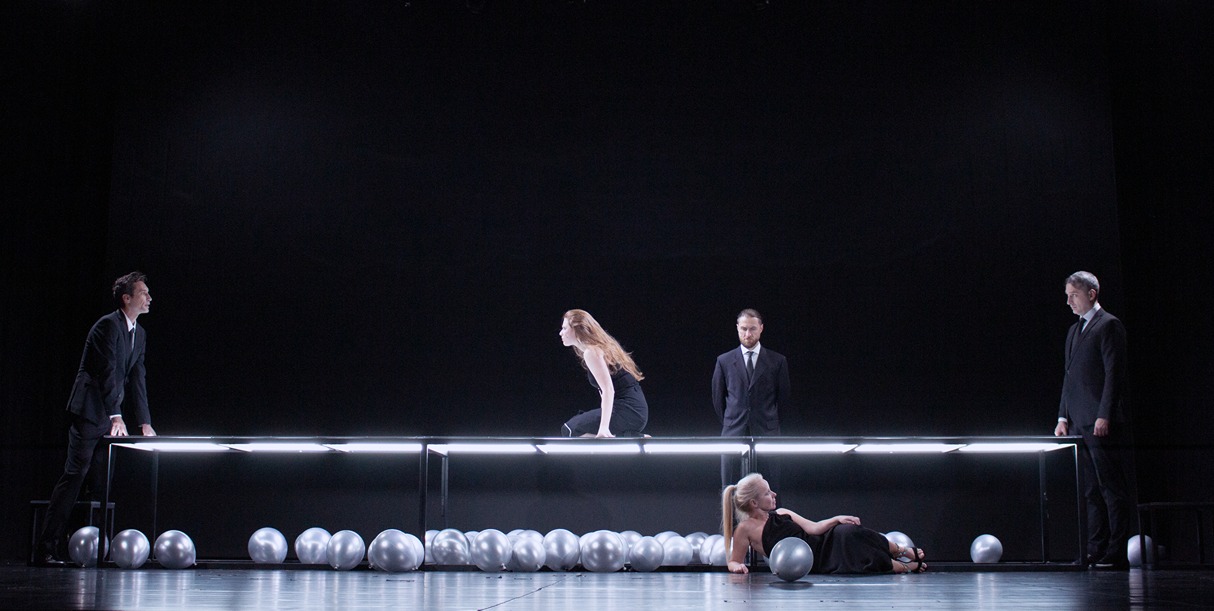
23 October | 19:00 – „I.L. Caragiale” National Theatre, Bucharest, Studio Hall

Chekhov’s Irina protests against self-delusion, a self-delusion that could become a way of life; she protests in the name of all persecuted Russian artists, who are opposing the bloodshed. The bustle of the daily rhythms, of the rhythms of our passions, ignites a fire. And hope emerges out of its ashes.
[same_day_events_link]
By: A.P. Cehov Translated by: Raluca Rădulescu
Cast:
Andrei Prozorov: Emanuel Becheru
Natalia: Corina Grigoraș
Olga: Elena Popa
Masha: Nora Covali
Irina: Teodora Crișan
Kulyghin Fyodor: Daniel Beșleagă
Vershinin Aleksandr: Mircea Postelnicu
Tuzenbach Nikolaj: Valentin Florea
Solyony Vassily: Paul-Ovidiu Cosovanu
Chebutykin Ivan: Dragoș Ionescu
Fedotek: Florin Hrițcu
Rode: Iulia-Paula Niculescu
Anfisa: Loredana Grigoriu
Children: Mara Obreja and Ana-Sofia Dăscălescu
Directed by: Theodor-Cristian Popescu
Concept and set design: Velica Panduru
Set: Velica Panduru (coproducer of the set: Tukuma Works)
Costumes: Sabina Reus
Choreography: Flavia Giurgiu
Original music: Andrei Raicu
Light design: Cristian Niculescu
Sound design: Andrei Raicu
Producer: Piatra Neamț Theatre of Youth
Recommended age: 16+
Duration: 2h 30min (one interval)
In Romanian with English surtitles
How will future generations look at us? What will they think of the way we lived? What is the meaning of it all? Chekhovian characters like to ask themselves such questions. And to express the anticipation of a significant change, coming soon, like a whirlwind.
But how can they pretend not to see? Not to see, on a small scale, the wide array of petty gestures around, but especially on a larger scale, the actions their country is undertaking? (Theodor-Cristian Popescu, director)
When we started the creative process for this show, we wondered what the characters’ path would be by using the filter of current political events, as related to the situation of the war in Ukraine.
Why would Irina want to go to Moscow? To mount resistance? To be the voice of her generation that does not submit to silence? Irina becomes the image of the women who protested peacefully, holding white flowers or blank sheets of paper, and who were arrested in Moscow.
Today, in the world we live in, surrounded by wars, it is necessary to have a position when we approach topics such as those in Chekhov’s texts, for example, to update history through our conceptual and artistic filters, analyzing the present. (Velica Panduru, set designer)
Photos: Velica Panduru, Sabina Reus